


Offset printing – the most popular printing technique
Offset printing is one of the most widely recognized printing methods. Therefore, it can be used for a broad range of products: leaflets, posters, brochures, magazines, and newspapers. Moreover, offset also works well for carton packaging, wobblers, and NCR forms, because it delivers good quality and high repeatability.
High productivity of offset presses helps reduce the unit cost at higher volumes. In addition, production runs quickly, therefore lead times often remain short. As a result, offset combines cost efficiency with very good print quality.
How does offset printing work?
The image does not go directly onto the paper
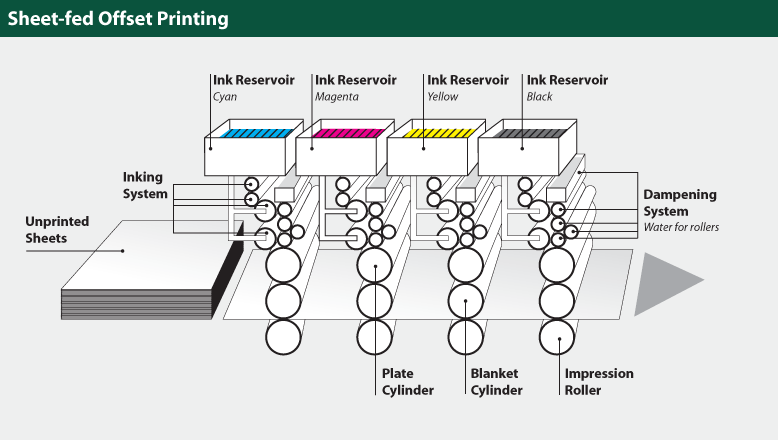
In offset, the image is transferred from the printing plate to the substrate via an intermediate cylinder. The intermediate cylinder is covered with a blanket (commonly called “rubber”). Therefore, ink is not transferred straight onto the paper. First, ink goes onto the plate cylinder, then the plate cylinder transfers the image to the blanket cylinder, and only afterwards the blanket cylinder transfers the image onto the material. Thanks to this, the process delivers a stable result and high print quality.

Types of offset printing
Although offset is associated with one technology, in practice it includes several solutions. Therefore, the most common division is sheet-fed offset and web offset (roll-fed). Moreover, the differences concern not only the substrate, but also production speed and the way the ink is cured.
Sheet-fed offset
In sheet-fed offset, paper or another material enters the press as sheets in a specific format. In addition, many printing houses in Poland rely on this solution. High-viscosity offset inks are used, which cure through absorption and polymerization. Then sheets move to the delivery unit, which stacks them. Moreover, even with IR drying or powdering, the stack must rest so the ink bonds properly with the paper.
In web offset, this “resting time” is usually not required, therefore production is faster. As a result, for projects with very tight deadlines, roll-fed printing can be a beneficial option.
Web offset (roll-fed)
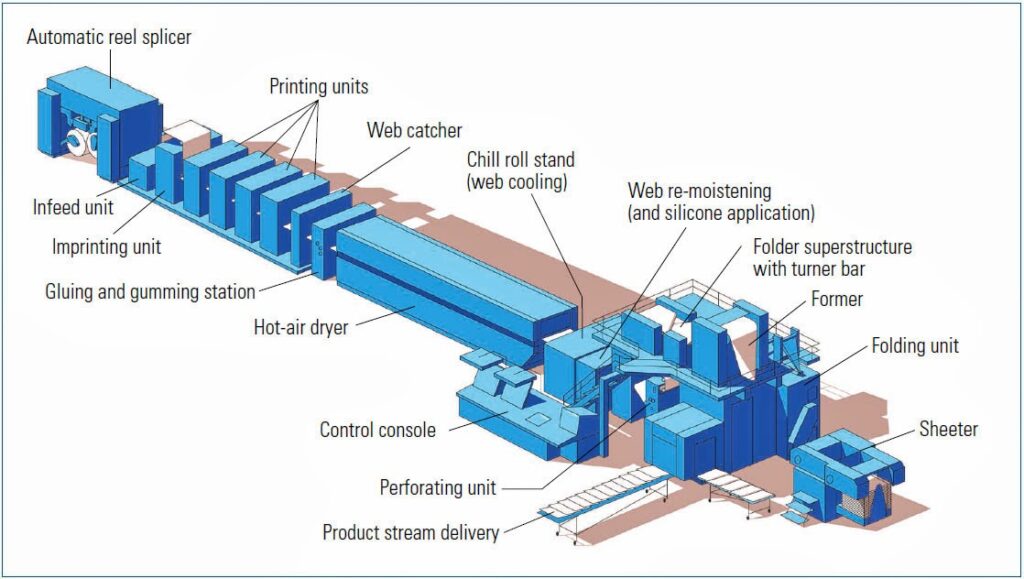
In web offset, the substrate comes as a web, meaning a roll. Moreover, this technology uses inks that differ from sheet-fed offset. In addition, roll-fed printing is typically produced in two main variants: coldset and heatset, which differ in how the ink is cured.
Coldset – “cold” offset
In coldset, the ink cures by being absorbed into the paper. Therefore, this method works well for very large volumes, however it most often applies to less quality-demanding jobs, for example advertising leaflets or newspapers.
Heatset – “hot” offset
In heatset, the process runs at very high temperatures, therefore the ink is absorbed and simultaneously evaporates. Moreover, this technique allows printing on thicker materials, and the result is clearly higher in quality. Therefore, printing houses use heatset for prestigious magazines and catalogues in very large runs.
Web presses can reach speeds several times higher than sheet-fed presses, therefore printing costs go down. In addition, in-line folding can deliver an almost finished product without extra steps. Moreover, paper in rolls is usually cheaper, which further improves profitability. Heatset commonly uses calendered and coated paper. In summary, the customer often receives the product at a lower price than with sheet-fed printing.
A short history of offset printing
Alois Senefelder and the beginnings of a breakthrough
The early roots of offset printing lead to Alois Senefelder (1771–1834). He was the son of an actor at the Royal Theatre, and he studied law because his father chose that path for him. However, after his father’s death everything changed, therefore Alois left his studies and went straight to the theatre, hoping for a fast career. Unfortunately, it soon turned out that acting was not for him, so he did not achieve stage success.
From scripts to a printing technique
Although he lacked acting talent, he gained more and more readers because he wrote scripts that captured attention. Over time he tried to distribute them, however he faced high printing costs and limited profit from sales. As a result, he visited printing houses frequently, and then he started working on his own by engraving copper plates. Moreover, this work was difficult and time-consuming, because he had to prepare a mirror image of what he wanted to achieve in the final print.

A discovery on stone
One day his mother asked him to write down a laundry list. Without paper at hand, he wrote it on a stone using soot mixed with soap and wax. Then he noticed an important relationship: water did not adhere to the areas covered with that substance, while ink behaved differently. From that moment he began drawing on stone and later transferring the image onto a matrix. Thanks to this, he patented his idea and became the father of lithography (from “lithos” – stone).
Want to learn more? Explore our knowledge section and see practical printing tips.