


Screen printing – technique, tools, and how the process works
Screen printing is a popular and widely recognized printing method. Importantly, you can use it on many materials, such as paper, board, film, metal, and even shaped parts. However, the technique became best known through the apparel industry. Moreover, screen printing works especially well on large, flat areas when you need strong, even coverage with dedicated screen inks.
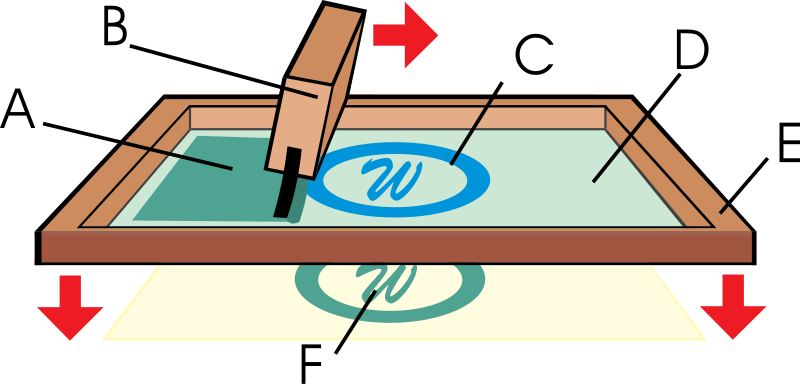
The key components include: A – Ink, B – Squeegee, C – Open mesh area, D – Mesh covered by stencil, E – Mesh frame, F – Printed graphic. Understanding these elements ensures proper preparation and execution of prints.
The screen is the foundation of screen printing
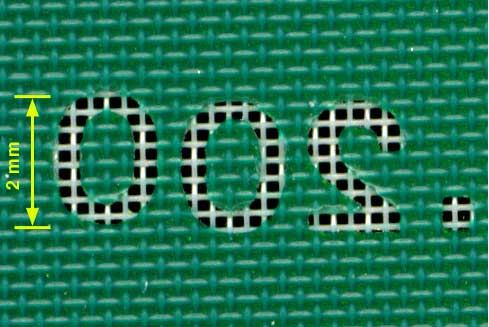
The most important element of the process is the screen: an aluminum frame with a special mesh stretched across it. This mesh transfers the ink. Once you block the mesh openings in non-printing areas, you create a working stencil (a matrix) that is ready for production. Then the ink passes through the open mesh areas. Additionally, standard meshes often have about 100–150 threads per cm², therefore they help deliver repeatable results.
How to create non-printing areas
- Manual blocking: apply a solution to the mesh, and after it dries it becomes impermeable.
- Drawing on the mesh: use ink or a lithographic crayon to define non-printing zones.
- Cut stencils: use paper or film stencils cut to shape.
- Photo emulsion: coat the mesh with light-sensitive emulsion, let it dry, and then expose it in a contact frame.
The squeegee and the inks
A squeegee pushes ink through the mesh. Depending on the job, it can vary in size, and it usually includes a handle, a flexible blade, and polymer components. Moreover, many people call it a “wiper,” because it effectively wipes ink across the open mesh cells.
In screen printing, water-based and plastisol inks are the most common. Water-based inks do not contain PVC or formaldehyde, therefore many consider them a favorable option. Additionally, they can work on very dense meshes and still deliver strong color saturation. Plastisol inks are thicker, so they cover less absorbent or less smooth substrates more easily. Moreover, they do not dry on the screen during printing, which streamlines production. You may also encounter solvent-based inks, UV inks, and specialist screen-printing adhesives.
How the printing process works
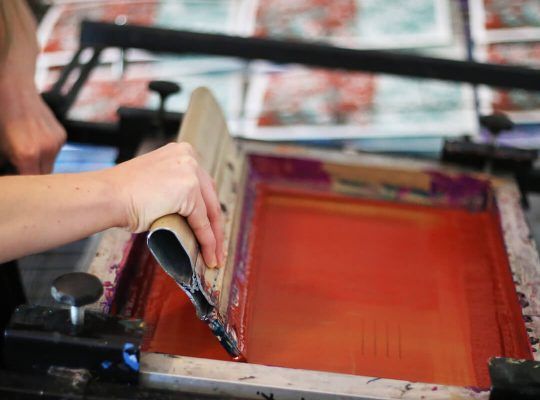
The process starts when you spread ink across the screen. Next, you move the squeegee, which forces ink through the open mesh cells directly onto the substrate. However, for round objects the workflow changes: the squeegee stays still, while the screen moves and the object rotates. Furthermore, modern screen-printing machines use servo drives that synchronize the speed of the screen and the product, therefore the output becomes more precise.
The history of screen printing: from Japan to today
Japan and kimono decoration
The origins of screen printing are linked to Japan, where as early as the 17th century the method was used to decorate kimonos. Interestingly, two key figures are Yuzensai Miyasaki and Zisukeo Hirose. The first decorated garments with this technique, while the second developed a paper stencil known as “katagami.” Moreover, much like today, the paper pattern was placed onto a mesh made of human or animal hair, stretched on a wooden frame. Additionally, in Fiji banana leaves were used to prepare stencils, therefore the history of screen printing shows the creativity of many cultures.
USA: technological breakthroughs
At the start of World War I, screen printing began to develop rapidly in the United States. Importantly, John Pilsworth from San Francisco created a way to print multiple colors from a single form, which streamlined the process. Next, a major invention was the Profilm shellac film by Louis F. D’Autremont, because it made stencil preparation easier. Soon after that, Joseph Ulano introduced a cellulose film which, notably, is still used today.
Europe, art, and underground print shops
In the 20th century, screen printing reached Europe and quickly became a valued printing technique. Moreover, serigraphy also started to function as an artistic tool, therefore it entered schools and studios. In Poland, during the 1970s and 1980s, screen printing played an important role in underground printing houses, which shows how significant it was in the realities of that time.
A Polish association and FESPA
Today, Poland has the Polish Screen Printing and Digital Printing Association, based in Kraków, which previously operated as the Association of Polish Screen Printers. The organization actively promotes knowledge about screen printing and regularly shares industry updates. Importantly, it is also a member of the international organization FESPA.